Background and overview
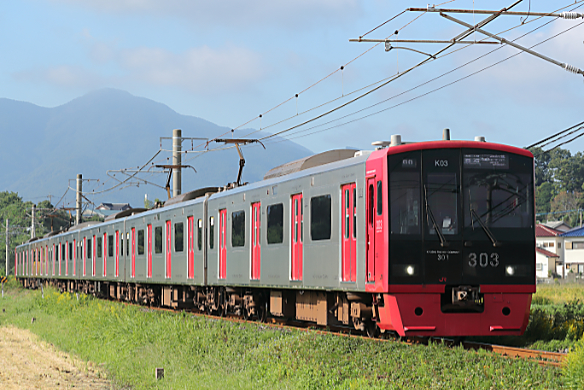
Background and Overview In 1999, JR Kyushu developed the 303 series DC commuter electric multiple unit (EMU) trains in preparation for the completion of double-tracking on the Chikuhi Line between Shimo-Yamato and Chikuzen-Maebaru, scheduled for 2000. Two six-car sets, each comprising four powered cars and two trailer cars, were built and assigned to the Karatsu Depot in 1999.
Car body
The carbody of the 303 series measures 19,500 mm in length and 2,800 mm in width, with a bogie centre distance of 13,800 mm. It features a lightweight stainless-steel structure utilizing a two-sheet construction method, in which a pressed stainless-steel inner sheet is combined with an outer sheet. These sheets themselves provide structural strength. Bolster beams, end sections of the centre beam, and selected cross beams are fabricated from weather-resistant steel plate (Steel Plate Atmospheric).
The floor height is set at 1,130 mm to lower the vehicle's centre of gravity
and eliminate the level difference between platform and floor, thereby
improving accessibility. The exterior consists of unpainted, bead-less
stainless-steel panels, with doors finished in red.
The cab ends, constructed from steel and painted red, incorporate an emergency
gangway with a plug door positioned slightly to the left of the cab. The
cab ends are covered with tempered glass. An LED destination indicator
is mounted behind the upper portion of the driver's side windscreen. Exterior
lighting includes two rectangular sealed-beam headlights positioned below
the windscreens and two rectangular taillights mounted externally.
Each car is equipped with four 1,300 mm-wide double-leaf automatic sliding doors, operated by pneumatic direct-drive mechanisms. The side panels are fitted with a fixed window measuring 1,950 mm in width between the doors, and a fixed window measuring 760 mm at the end of the carbody. All windows employ UV-cut, heat-absorbent glass to enhance thermal insulation.
Roof-mounted air conditioning units (AU407K), rated at 42,000 kcal/h, are installed on each car. Roof-mounted electric fans are provided to exhaust indoor air. Additional equipment includes an LED destination display and two loudspeakers mounted on each side of the carbody to support passenger announcements.
Bogies
The powered bogies are designated as type DT405K, while the trailer bogies are type TR405K. Both types feature a bolster-less design with secondary suspension employing air springs. Journal support is provided by cone-shaped multilayer rubber springs and a single-link draw gear. Conical roller bearings are adopted to ensure smooth ride characteristics even at speeds up to 110 km/h. The use of smaller-diameter wheels (810 mm) contributes to lowering the floor height.
Power transmission is achieved through Twin Disc (TD) flexible joints incorporating deflecting plates made of carbon-fiber-reinforced plastic (CFRP). The gear ratio is set at 6.5 to optimize acceleration performance across medium- and high-speed ranges.
Both powered and trailer bogies are equipped with single-tread brake rigging.
Traction system and ancillary equipment
Each powered car is equipped with four MT401K three-phase asynchronous motors, each rated at 150 kW. These motors are controlled via the PC403K variable-frequency drive system, which is installed on Class Moha303 vehicles and governs both cars in a fixed married-pair configuration with Class Moha302. This system implements vehicle-based control and incorporates a two-level inverter utilizing insulated gate bipolar transistors (IGBTs).
To ensure braking reliability under conditions where regenerative braking may be ineffective—such as on single-track sections with low power demand—the 303 series employs an electrically commanded braking system that combines regenerative and rheostatic braking. The PC403K system includes a braking chopper unit to facilitate smooth transition to rheostatic braking when regeneration is not feasible.
Current collection is achieved via PS402K single-arm pantographs mounted on the roofs of Class Moha303-100 and Class Moha302-100 vehicles.
Auxiliary systems are installed on Class Moha302 vehicles, which are fitted with SC406K auxiliary power supply units delivering an output of 150 kVA, also employing IGBT technology. These vehicles are additionally equipped with motor-driven reciprocating-type air compressors of type TC2000, providing compressed air for braking and door operation.
End cars are equipped with an onboard ATO system for automatic train operation, as well as ATC-9 and ATS-SK onboard signaling systems mounted beneath the floor.
Accommodation
Passenger seating consists of longitudinal bench seats having 460 mm wide per person, formed from aluminum plates that integrate both the seat and backrest, while maintaining independent seat and back contours. A wheelchair space is provided at one end of the saloon. Roller blinds on the side windows have been discontinued.
All gangways are 1,100 mm wide, regardless of door presence. No gangway doors are provided between the married-pair powered cars. Passenger information is displayed via LED indicators mounted on the door headers. Interior illumination is provided by fluorescent light fixtures arranged in two parallel rows along the ceiling, ensuring uniform lighting across the cabin.
The driver's cab is equipped with a one-handle master controller operated
by the left hand.
Additional delivery
In 2002, one additional set was delivered. This set is equipped with a
route map-type passenger information display.
Modification
In 2003, Class Kuha303 cars were retrofitted with universal access toilets. The window at the location of the toilet compartment was replaced with a blank panel. The facilities employ a vacuum toilet system and are located at the rear end of the carbody.
Operations
The 303 series entered revenue service in December 2000. Currently, 303 series EMUs are assigned to the Chikuhi Line between Meinohama and Nishi-Karatsu, including interrunning services on the Fukuoka City Subway Kuko Line. |
|
| Technical Data |
| Items |
Data |
| Supply Voltage |
1,500 V DC |
| Service
speed, etc. |
Acceleration: 3.3 km/h/s Deceleration: 3.5 km/h/s Service speed: 110 km/h |
| Length |
19,500 mm |
| Width |
2,800 mm |
| Height |
4,036 mm |
| Bogie |
DT405K (motored), TR405K (trailer) |
| Collector |
PS402K (single-arm) |
| Traction
motor |
MT401K (150 kW) |
| Gear ratio |
6.50 |
| Traction system |
2-level variable-frequency drive (IGBT): PC403K |
| Air conditioner |
AU407K (42000kcal/h×1) |
| Designed
by |
JR Kyushu |
|
|