Background and Overview
The entire Senseki Line, which was destroyed, heavily damaged, and flooded by the 2011 Tohoku earthquake and tsunami, was fully restored and reopened in 2015. In conjunction with this restoration, JR East introduced inter running services branded as the “Senseki Tohoku Line,” linking Sendai and Ishinomaki by connecting the AC electrified Tohoku Line and the DC electrified Senseki Line via a newly constructed unelectrified connecting line. To support these services, JR East developed the HB E210 series hybrid diesel multiple unit (DMU) trains in 2015.
In the same year, eight two car sets—each consisting of a class HB E211 single ended vehicle equipped with a toilet and a class HB E212 single ended vehicle without a toilet—were built and allocated to the Kogota Depot.
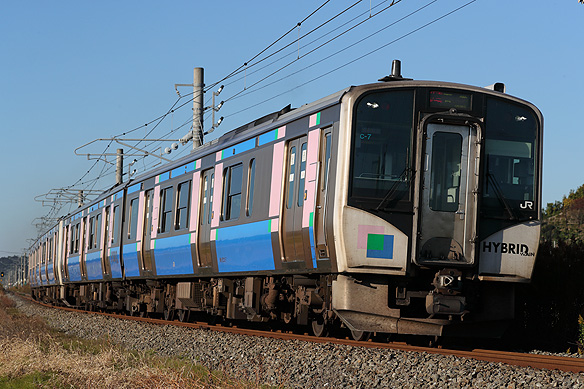
Car body
The carbody of the HB E210 series measures 19,570 mm in length and 2,950 mm in width, with a bogie centre distance of 13,800 mm. The structure is primarily composed of lightweight stainless steel, except for the bolster beams, the end sections of the centre beam, and selected cross members, which are fabricated from corrosion resistant steel plate. The floor height is set at 1,130 mm to lower the vehicle’s centre of gravity and eliminate the level difference between the platform and the floor, thereby improving accessibility. The exterior consists of unpainted, smooth stainless steel panels without stiffening beads. The frieze boards and the wainscot panels between the doors are finished in blue with pink coloured accents adjacent to the doors.
The cab end incorporates a gangway and is framed with decorative FRP panels. A low profile driver’s cab is adopted to accommodate future conductor less operation. Above the gangway door, an LED destination display is installed. LED headlights and taillights are mounted behind the upper portion of the windscreens.
Each car is equipped with three 1,300 mm wide double leaf automatic sliding doors, operated by pneumatic direct drive mechanisms with attenuated closing force. Manual operation is enabled via push button controls adjacent to each door. Provisions are included for the future installation of an LED display indicating conductor less operation.
Between the doors, the side panels are fitted with two integrated window units, each measuring 1,655 mm in width. Each unit consists of a wide drop window combined with a narrow-fixed window, forming a horizontally aligned assembly. At each end of the carbody, an additional fixed window measuring 1,340 mm in width is installed. All windows employ heat absorbent double glazing glass to enhance thermal and acoustic insulation and prevent condensation.
Roof mounted air conditioning units (AU732A), each rated at 33,000 kcal/h, are installed on every car. The exhaust pipe from the prime mover is routed adjacent to the rear door on class HB E211 vehicles and through the front section between the doors on class HB E212 vehicles.
Additional equipment includes an LED destination display located at the rear of class HB E211 vehicles and two loudspeakers mounted on each side of the carbody to support automated passenger announcements. All end cars employ automatic coupling and uncoupling mechanisms to facilitate rapid trainset reconfiguration during peak operations.
Bogies
The powered bogies are designated as type DT75B, while the trailer bogies are classified as type TR260B. Both types feature bolster‑less secondary air suspension, a trailing‑arm link journal box support system, and a single‑link draw gear. The DT75B and TR260B bogie families also incorporate a bow‑shaped frame design to lower the bolster suspension height, contributing to a reduced floor level and improved vehicle stability.
Power transmission is achieved through Twin Disc (TD) flexible joints employing deflecting plates made of carbon‑fiber‑reinforced plastic (CFRP), and the gear ratio is set at 7.07 to optimize acceleration performance across medium‑ and high‑speed ranges.
Both bogie types are equipped with single‑clasp tread brake rigging incorporating automatic gap‑adjusting mechanisms.
Power train and ancillary equipment
The HB‑E210 series adopts a series‑hybrid system powered by electricity generated from both an onboard generator and lithium‑ion batteries. This hybrid system operates in four modes. When starting from standstill, energy stored in the lithium‑ion batteries is used to drive the traction motors, with the engine cut out. Above approximately 15 km/h, the system draws electricity from both the batteries and the engine‑driven generator. During coasting, the engine is cut out and all auxiliary loads are supplied from the batteries. When braking, the engine is cut out and the traction motors function as generators, recharging the batteries.
Each vehicle is equipped with a DMF15HZB‑G four‑cycle straight‑six diesel prime mover delivering 450 PS. These engines feature exhaust‑gas‑driven turbochargers and a common‑rail direct fuel‑injection system that significantly reduces exhaust emissions, particularly NOx. A squirrel‑cage induction generator, type DM113, rated at 270 kW, is directly coupled to each prime mover via a flexible plate coupling.
The traction system, designated as CI24, consists of a two‑level PWM converter, a two‑level variable‑frequency drive (VFD), and an auxiliary power supply delivering up to 70 kVA. The generated three‑phase AC power is rectified by the converter section of the traction system, and two MT78 asynchronous traction motors, each rated at 95 kW, are controlled by the VFD on a per‑bogie basis.
Each vehicle is equipped with two roof‑mounted MB1 lithium‑ion traction batteries with a total capacity of 15.2 kWh, as well as a motor‑driven reciprocating air compressor (type MH3125‑C600N) mounted beneath the floor to supply compressed air for braking and door operation.
The braking system incorporates electronic control and supports both regenerative and holding brake functions.
Accommodation
The interior of the HB‑E210 series is arranged with a hybrid seating configuration tailored for regional service. Between the doors, the central section is fitted with 2+2 abreast transverse seating bays, while two‑seat longitudinal bench‑type bucket seats, providing 460 mm of width per person, are installed adjacent to the doors. The equipment room for the hybrid system is located in the rear section between the doors, with the longitudinal bench seating positioned across the aisle from the equipment room. This layout ensures consistency across the fleet while accommodating the differing orientations of each car type. All seating adopts cantilever construction to facilitate under‑seat cleaning and improve legroom.
Triangular hand straps in grey are installed throughout the interior, with orange‑coloured straps provided near priority seating areas for visual distinction.
For illumination, the interior is equipped with two rows of ceiling‑mounted LED light fixtures. LED passenger information displays are mounted above the door headers to ensure visibility from multiple angles.
Class HB‑E211 vehicles are equipped with a wheelchair‑accessible space and a universal‑access vacuum toilet located toward the rear of the passenger compartment. The toilet system utilizes vacuum‑flushing technology to improve sanitation and reduce water consumption.
The driver’s cab is designed as a left‑side compartment type to support conductor‑less operation. The control desk is fitted with a single‑handle master controller operated by the left hand.
Provisions are included for the future installation of a fare box and a fare chart display for conductor‑less operation.
ModificaOperation
The HB E210 series was delivered to the Kogota Depot in 2015 and entered service on the “Senseki Tohoku Line,” linking Sendai and Ishinomaki via the Tohoku Line and the Senseki Line, in May of the same year. The trains were also deployed on regional services between Ishinomaki and Onagawa in 2016.
At present, the HB E210 series is operated on rapid and special rapid services via the Tohoku and Senseki Lines. |
|