Background and Overview
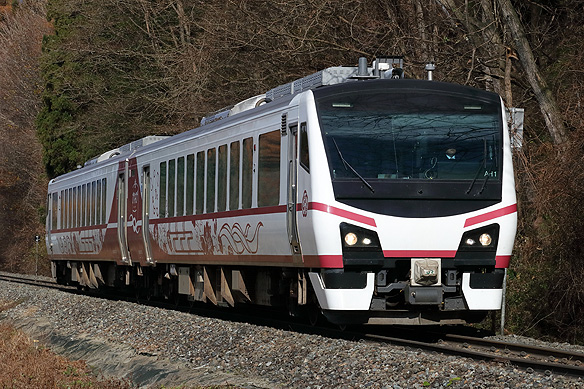
In 2010, JR East developed the HB-E300 series hybrid diesel multiple unit (DMU) trains for excursion services on the Tsugaru, Ominato, and Gono lines, in conjunction with the extension of the Tohoku Shinkansen from Hachinohe to Shin-Aomori. The HB-E300 series consists of intermediate cars (Class HB-E300) and end cars (Classes HB-E301 and HB-E302).
One two-car set for the “Resort View Furusato” service was delivered to the Nagano Depot, two two-car sets for the “Resort Asunaro” service to the Aomori Depot, and one four-car set for the “Resort Shirakami - Aoike” service to the Akita Depot.
Car body
The carbody of the HB‑E300 series measures 20,600 mm in length and 2,920 mm in width, with a bogie centre distance of 14,400 mm. The structure is primarily composed of lightweight stainless steel, except for the bolster beams, the end sections of the centre beam, and selected cross members, which are fabricated from corrosion‑resistant steel plate. The floor height is set at 1,130 mm to lower the vehicle’s centre of gravity and eliminate the level difference between the platform and the floor, thereby improving accessibility.
The non-gangwayed cab ends, which have no gangway door and feature a wide windscreen to provide a commanding view of the track ahead, are constructed from steel plate. They are flanked by a longitudinally arranged high‑intensity discharge (HID) lamp and an externally mounted sealed‑beam headlight on each side. Tail lamps are installed behind the upper part of the windscreen. Anti‑fall plates are provided between vehicles, except at the cab ends.
Each car is equipped with a 1,100 mm-wide single‑leaf sliding door at the rear. Side windows include an 1,800 mm-wide fixed window at the observation area behind the cab, 1,200 mm-wide fixed double-glazing windows for each compartment of class HB‑E300‑100 vehicles, and 950 mm-wide fixed double‑glazing units for each reclining seat. Each car is fitted with a loudspeaker on both sides toward the rear, and classes HB‑E300‑0 and HB‑E301 are equipped with an LED destination display.
An AU732A roof‑mounted air‑conditioning unit, rated at 33,000 kcal/h, is installed on each vehicle. Fresh air is supplied to the passenger compartment via an electric fan integrated into the air‑conditioning unit, eliminating the need for separate roof ventilators. The exhaust pipe from the prime mover is routed through the equipment room located toward the rear of the passenger saloon.
Close‑contact couplers are employed between vehicles. All end cars are equipped with automatic coupling and uncoupling mechanisms to facilitate rapid trainset reconfiguration during peak operations.
The exterior consists of unpainted, smooth stainless‑steel panels without stiffening beads.
The cab ends of the set for the “Resort View Furusato” service are finished in white, with side panels finished in yellow‑green at the observation area and green in the passenger saloon.
The cab ends of the sets for the “Resort Asunaro” service are finished in silver, with side panels finished in green at the observation area and horizontal red and yellow stripes in the passenger saloon.
The cab ends of the set for the “Resort Shirakami - Aoike” service are finished in white, with side panels finished in blue.
Bogies
The powered bogies are designated as type DT75A, while the trailer bogies are classified as type TR260A. Both types feature bolster-less secondary air suspension, a trailing-arm link journal box support system, and a single-link draw gear. The DT75A and TR260A bogie families also incorporate a bow-shaped frame design to lower the bolster suspension height, contributing to a reduced floor level and improved vehicle stability.
Power transmission is achieved through Twin Disc (TD) flexible joints employing deflecting plates made of carbon-fiber-reinforced plastic (CFRP), and the gear ratio is set at 7.07 to optimize acceleration performance across medium- and high-speed ranges.
Both bogie types are equipped with single-clasp tread brake rigging incorporating automatic gap-adjusting mechanisms.
Power train and ancillary equipment
The HB‑E300 series adopts a series‑hybrid system powered by electricity generated from both an onboard generator and lithium‑ion batteries. This hybrid system operates in four modes. When starting from standstill, energy stored in the lithium‑ion batteries is used to drive the traction motors, with the engine cut out. Above approximately 25 km/h, the system draws electricity from both the batteries and the engine‑driven generator. During coasting, the engine is cut out and all auxiliary loads are supplied from the batteries. When braking, the engine is cut out and the traction motors function as generators, recharging the batteries.
Each vehicle is equipped with a DMF15HZB‑G four‑cycle straight‑six diesel prime mover delivering 450 PS. These engines feature exhaust‑gas‑driven turbochargers and a common‑rail direct fuel‑injection system that significantly reduces exhaust emissions, particularly NOx. A squirrel‑cage induction generator, type DM113, rated at 270 kW, is directly coupled to each prime mover via a flexible plate coupling.
The traction system, designated as CI20, consists of a two‑level PWM converter, a two‑level variable‑frequency drive (VFD), and an auxiliary power supply delivering up to 70 kVA. The generated three‑phase AC power is rectified by the converter section of the traction system, and two MT78 asynchronous traction motors, each rated at 95 kW, are controlled by the VFD on a per‑bogie basis.
Each vehicle is equipped with two roof‑mounted MB1 lithium‑ion traction batteries with a total capacity of 15.2 kWh, as well as a motor‑driven reciprocating air compressor (type MH3125‑C600N) mounted beneath the floor to supply compressed air for braking and door operation.
The braking system incorporates electronic control and supports both regenerative and holding brake functions.
Accommodation
The seating and compartment floors are elevated 130 mm above the main floor level to provide passengers with a commanding view of the wayside scenery through the windows.
Class HB‑E300‑100 vehicles feature a side corridor with nine semi‑compartments, each consisting of a transverse seating bay with a seating pitch of 1,850 mm. Pairs of seats can be arranged on either side of the centre of the compartment to create a flat lounging area, and a fixed table is installed at the centre of each compartment.
In contrast, the seating accommodation in the other vehicles consists of 2+2 abreast reclining seats with a seating pitch of 1,200 mm. An LED passenger information display is mounted on the gable wall, and two 17‑inch LCD monitors are installed beneath the ceiling to broadcast video programmes. The observation area is located directly behind the cab and is furnished with benches and sofas.
Class HB‑E301 and HB‑E300‑0 vehicles are equipped with a vacuum universal‑access toilet, a vacuum‑flush urinal, and a washroom. Class HB‑E301‑100 vehicles are additionally equipped with a catering room located beside the doorway.
Additional delivery
A set branded as “Resort Shirakami - Buna”
An additional four-car set branded as “Resort Shirakami - Buna” was delivered to the Akita Depot in 2016 to increase capacity for Resort Shirakami services. The cab end is finished in dark green, and the lighting equipment was upgraded: the sealed-beam headlights were replaced with LED units, and the number of HID lamps was increased to two per side.
The side panels are fully wrapped with vinyl film depicting beech-tree illustrations. Interior upgrades include new upholsteries and wall panels. The traction system was also upgraded to the CI24 type. Three rows of reclining seats were removed to install a service counter offering drinks and light meals.
A set branded as “Kairi”
A four-car set branded as “Kairi” was delivered to the Niigata Depot in 2019. The cab ends are finished in metallic vermilion, featuring five vertically arranged LED headlights on each side. The side panels are fully wrapped with vinyl film in a vermilion‑to‑white color gradient, accented by a black band surrounding the side windows.
An event space and a service counter are installed in the HB‑E300‑0 car. The service counter is equipped with three sinks, a hot‑water dispenser, a refrigerator, a freezer, and a heating cabinet. Two side windows located toward the rear on each side employ double‑hung windows, consisting of a downward‑sliding upper sash and a fixed lower sash, allowing passengers to enjoy fresh outside air.
The accommodation of the HB‑E302 car consists of an observation area directly behind the cab, 2+1 abreast transverse seating bays in the middle section, and two two‑seat benches facing the windows toward the rear.
Modification
Two sets for the “Resort Asunaro” service were modified in 2023
Class HB‑E302‑0 vehicles were upgraded to first class and reclassified as class HB‑E302‑700. The original reclining seats were completely removed and replaced with three four‑seat transverse seating bays on the right, five two‑seat transverse seating bays on the left, and three single seats facing the windows, located to the rear of the four‑seat bays. Each transverse seating bay is equipped with a table at its centre. An existing window behind the two‑seat bays was sealed to create space for a luggage area.
The upholsteries of the reclining seats in class HB‑E301 vehicles were refurbished.
The livery of the Hinabi set features a white base with a narrow waistline band and headline bands above and below the side windows, incorporating illustrations such as a mountain motif at the centre of the train and patterns representing flowing rivers and drifting flowers between the bands.
In contrast, the livery of Satono consists of a yellow‑green class HB‑E302 vehicle with green and dark‑green wide stripes below the windows, paired with a light‑blue class HB‑E301 vehicle featuring blue and dark‑blue wide stripes below the windows. Both sets are accented by a grey band surrounding the side windows, with a narrow yellow band along the lower edge of the grey band. |
|