Background and overview
JR East developed the E721 series AC suburban electric multiple units to
replace the aging 455, 417, and 717 series EMUs operating on the Tōhoku,
Jōban, and Ban’etsu West lines. A total of thirty‑nine two‑car formations—each
consisting of one powered car and one trailer car—were delivered to the
Sendai Depot between November 2006 and November 2009.
Car body
The carbody of the E721-0 series measures 19,570 mm in length and 2,950 mm in width, with a bogie centre distance of 13,800 mm. The structure is primarily composed of stainless steel, except for the bolster beams, the end sections of the centre beam, and selected cross beams, which are fabricated from weather-resistant steel plate (Steel Plate Atmospheric).
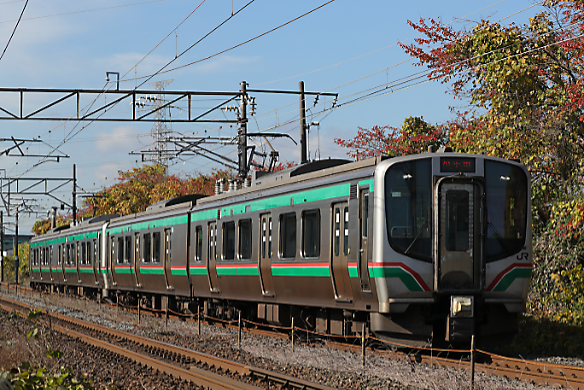
The exterior consists of unpainted flat stainless-steel panels with no bead embossing, complemented by a green waistline band, narrow white and red bands below the windows, and an additional green band above the windows.
Structural reinforcement is provided by a ring-shaped arrangement of longitudinal members—including underframe cross members, side columns, and carlines—and by the use of high tension stainless steel designated SUS304N2, improving resistance to lateral collision forces.
The floor height is set at 950 mm, closely matching the 920 mm platform height adopted in the Sendai area, in order to reduce the step between the platform and the car floor.
The cab end incorporates a gangway and is framed with decorative FRP panels. A low-profile driver’s cab, matching the height of that on the 701 series EMUs, is adopted to accommodate future conductor less operation. An LED destination display is installed above the gangway door. High-intensity discharge (HID) headlights and LED taillights are mounted behind the upper portion of the windscreens, and an obstacle deflector with a miniature snowplough is fitted beneath the cab.
Each car is equipped with three double-leaf automatic sliding doors per side, each 1,300 mm wide and actuated by pneumatic direct-drive mechanisms mounted on the door headers. These mechanisms incorporate attenuated closing force, and manual operation is enabled via push-button controls adjacent to each doorway.
Between the doors, the side panels are fitted with two integrated window units, each measuring 1,675 mm in width. Each unit consists of a wide drop window combined with a narrow-fixed window, forming a horizontally aligned assembly. At each end of the carbody, an additional fixed window measuring 1,115 mm in width is installed. All windows employ heat absorbent double-glazing glass to enhance thermal and acoustic insulation and to prevent condensation.
Additional exterior equipment includes an LED destination display and two loudspeakers mounted on each side of the carbody to support passenger announcements.
Roof mounted air-conditioning units (AU730), each rated at 42,000 kcal/h, are installed on every car. Electric fans within the units supply fresh air into the passenger saloon, eliminating the need for roof mounted ventilators.
Tight-lock couplers with automatic jumper couplers are provided at the cab end to facilitate rapid coupling during rush-up operations.
Bogies
The powered bogies are designated DT72, while the trailer bogies are classified as TR256. Both bogie types employ bolster-less secondary air suspension, a trailing‑arm link journal box support system, and a single‑link draw gear. To reduce the floor height, the wheel diameter is minimized to 810 mm, and an extremely arched bogie frame is adopted.
Power transmission utilizes Twin Disc (TD) flexible couplings with carbon-fiber-reinforced plastic (CFRP) deflecting plates, with a gear ratio of 5.93.
The braking configuration differs between bogie types: powered bogies are equipped with single-tread brake rigging, while trailer bogies combine single-disc brake units with single-tread brake rigging.
Traction unit and ancillary equipments
Class KumohaE721-0 cars are equipped with the CI14 traction system, which controls four AC asynchronous motors (type MT76) on a per-bogie basis, each rated at 125 kW. The traction system comprises a three-level PWM converter and a three-level variable-frequency drive (VFD), both utilizing IGBT modules and enabling field-oriented control.
Class KumohaE721-0 cars are additionally fitted with a traction transformer (TM32) mounted beneath the floor, and a single-arm pantograph (PS109) installed on the roof.
Class KuhaE720 cars are equipped with a dual-output auxiliary power supply unit (SC84) rated at 12 kVA, along with two air compressors (MH1112-C1600-MF) employing IGBT modules. Both units are mounted beneath the floor.
The braking system is an electrically commanded brake with regenerative braking. It incorporates trailer‑priority brake control logic to optimize braking performance across the trainset.
Each vehicle is equipped with an onboard ATS-PS signalling system mounted beneath the floor.
Accommodation
The interior of the E721-0 series is arranged with a hybrid seating configuration
tailored for regional services. Longitudinal bench-type bucket seats, providing
460 mm of width per passenger, are installed adjacent to the doorways and
at each end of the saloon. The central section between the doors is fitted
with 2+2 transverse seating bays with a seat pitch of 1,585 mm. These seats
adopt a cantilever construction to facilitate under-seat cleaning and improve
legroom. All seats employ no-sag springs to support the seat cushions.
LED passenger information displays are mounted above the door headers.
Triangular hand straps in grey are installed throughout the interior, while yellow-coloured straps are provided near priority seating areas for visual distinction.
The air-conditioning ductwork is housed above the ceiling to maintain a clean interior profile, with slit-type vents providing evenly distributed airflow. Illumination is provided by fluorescent fixtures arranged in two parallel rows along the ceiling.
Class KuhaE720 vehicles are equipped with a wheelchair-accessible space and a universal-access vacuum toilet located toward the rear of the passenger compartment. The toilet system employs vacuum-flushing technology to improve sanitation and reduce water consumption.
The driving cab is fitted with a single‑handle master controller operated with the left hand.
Provisions are included for the future installation of monitors receiving millimetre-wave-band video signals from platform‑mounted cameras to support boarding and alighting confirmation during conductor‑less operation.
Additional delivery
In 2010, five additional sets were delivered to replace the 719 series EMUs operating on the Ban’etsu West Line. From this batch onward, equipment for conductor-less operation was introduced. Ticket-issuing machines, which dispense boarding‑station tickets, are installed adjacent to the rear doorways; fare boxes are positioned behind the driver’s cab; and a fare-chart LCD display is mounted above the front gangway door.
Modification
E721-500 series
In 2020, a set consisting of KumohaE721‑5 and KuhaE720‑5 was retrofitted with monitors receiving millimetre‑wave‑band video signals from platform‑mounted cameras to provide additional capacity for commuter services on the Sendai Airport Line.
This retrofit does not include the luggage space provided on newly built E721‑500 series vehicles.
Reserved seating installation for “Aizu” rapid services
In 2020, seats located at the rear section between doors of KuhaE720-5 were upgraded to reclining seating with 960 mm seating pitch.
Withdrawal
Two sets — a pair consisting of KumohaE721-1 and KuhaE720-1, and another pair consisting of KumohaE721-19 and KuhaE720-19 — were derailed and severely damaged by the 2011 Tōhoku earthquake and tsunami on 11 March 2011 while standing at Shinchi Station.
Both sets were subsequently written off and scrapped
Operations and transfer
The E721-0 series was delivered to the Sendai Depot in 2007 and entered service on regional operations on the Tohoku, Joban, and Senseki Lines in the same year.
Vehicles equipped for conductor-less operation were also deployed on rural services on the Banetsu-West Line in 2017.
At present, trainsets configured for conductor‑less operation are deployed
on the Banetsu‑West Line between Koriyama and Aizu-Wakamatsu, while the
remaining sets operate on the Tohoku Line between Shin‑Shirakawa and Ichinoseki,
the Joban Line between Haranomachi and Iwanuma, and the Ou Line between
Uzen-Chitose and Yamagata.. |
|