Background and overview
In 2017, JR East introduced pre production sets of the KiyaE195 series non revenue diesel multiple units to replace aging locomotive hauled trains used for transporting rails for track renewal work. The design is based on JR Central’s Kiya97 series, but incorporates modifications such as JR East compatible onboard signalling equipment and enhanced protection for operation in snowy and cold weather environments.
The KiyaE195 series is produced in two configurations: the 0 subseries, formed as eleven car sets for transporting continuous welded rails, and the 1000 subseries, formed as two car sets for transporting jointed rails. One set of each type was initially delivered to the Kogota Depot in 2017.
Car body
The vehicles have steel carbodies measuring 17,800 mm in length and 2,800 mm in width, with a bogie centre distance of 12,000 mm. The underframe adopts an inverted fish‑belly configuration using steel beams. The cab structure is made of stainless‑steel plate, except for the cab front, which is constructed from steel plate.
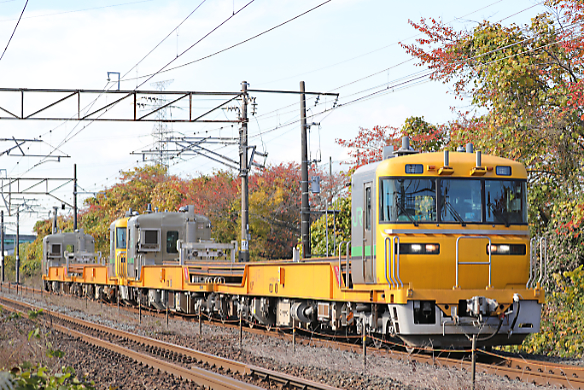
The KiyaE195‑0 and KiyaE195‑100 subseries feature gangwayed cabs. The cab is positioned at a higher level to provide access to the rails loaded on the cargo bed from the front of the vehicle. A hinged door and stairs are installed on the rear wall of the cab section to allow safe crew access. Rail‑handling equipment is mounted at the forward end of the loading area. The exhaust pipe of the prime mover is fitted externally on the cab-end plate. Exterior lighting consists of two rectangular LED headlights above the gangway door, two sealed‑beam headlights on either side of the gangway, and two externally mounted taillights.
In contrast, the KiyaE195‑1000 and KiyaE195‑1100 subseries are equipped with non‑gangwayed cabs, with a platform and safety fences provided in front of the cab for the ground guide during shunting operations. Because loading and unloading are performed using a crane, the distance between the rear of the cab and the loaded rails is maintained at more than 2 meters. The three‑section windscreen incorporates curved glass panes. Exterior lighting consists of a rectangular LED headlight positioned above either the left or right windscreen, two headlights below, and an externally mounted rectangular LED taillight. A hinged door is provided on each side of the cab, and the exhaust pipe of the prime mover is mounted externally on the cab-end plate.
The exterior livery is yellow, including the cab front, with a green band applied to each side of the cab.
The vehicles are fitted with tight-lock automatic couplers.
Bogies
The development of the bogies focused on three key objectives. The first was to maintain running stability both with and without rail loads. The second was to ensure sufficient structural strength to withstand the lateral forces generated by loaded rails while minimizing side thrust. The third was to achieve running stability at high speeds comparable to that of passenger rolling stock.
The trains are equipped with DT86 powered bogies and TR269 trailer bogies, both featuring bolsterless secondary air suspension. The axleboxes are made of cast steel and supported by a primary suspension system consisting of nonlinear coil springs combined with cylindrical laminated rubber elements. The air springs, with a diameter of 560 mm, are sized to accommodate the variable load conditions. Each bogie is fitted with brake rigging incorporating a double‑tread unit.
Powertrain and ancillary equipment
The vehicles are powered by a DMF14HZC prime mover manufactured by Cummins Inc. This four‑cycle, straight‑six diesel engine develops 360 PS and is equipped with an exhaust‑gas‑driven turbocharger and an aftercooler. Power is transmitted through a DW19B hydraulic transmission, which incorporates a three‑element single‑stage torque converter, a multi‑plate wet clutch, and a five‑speed output arrangement consisting of two torque‑converter gear stages and three direct‑coupled gear stages. The transmission also includes a spring clutch that enables constant‑low‑speed operation, allowing the vehicle to maintain speeds of 1.5 km/h, 3 km/h, or 4.5 km/h.
The prime mover and hydraulic transmission are managed by a transmission control unit (TCU), which converts commands from the master controller into fuel‑control signals. These signals are processed by a fuel control unit, which outputs an analogue voltage to the engine control unit (ECU) to regulate fuel injection quantity.
Each powered car is equipped with an underfloor‑mounted C600 air compressor and a DM108 generator, both driven by the prime mover. The braking system is an electrically commanded pneumatic brake supplemented by a retarder and engine braking. When engine braking alone cannot provide the required braking force, the pneumatic brake system automatically supplements it.
Loading device
The Kiya E195‑1000 series is equipped with rail‑locking devices, guide assemblies, and a lifting platform. In addition to these components, the Kiya E195‑0 series is also fitted with rail‑unloading aprons, winches, rail‑traversing devices, and other equipment required for loading and unloading operations.
Additional delivery
JR East delivered twenty two sets of the 1000 subseries in 2020 and three
sets of the 0 subseries in 2021.. |
|