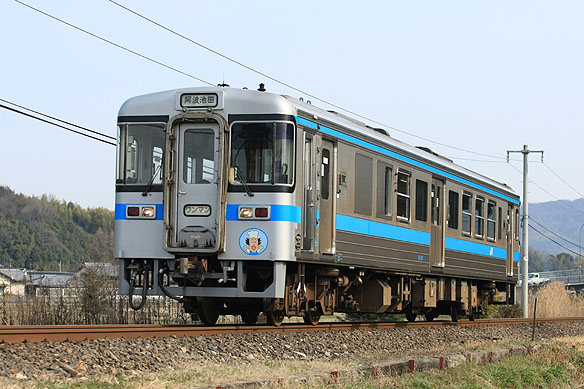
Background and overview
DMU trains inherited from Japanese National Railways were used for commuter services in the Tokushima and Kochi regions, and they were refurbished between 1987 and 1988. However, their performance was insufficient to reduce journey times. To address this, JR Shikoku developed the double ended Class 1000 DMU, offering higher performance and improved passenger services to replace the superannuated DMU fleet. A total of 28 vehicles were delivered to the Tokushima Depot between January and March 1990.
Car body
The vehicles have carbodies measuring 21,300 mm in length and 2,894 mm
in width, with a bogie centre distance of 14,400 mm. The structure is constructed
primarily of stainless steel to achieve a lightweight body, except for
the bolster beams, the end sections of the centre beam, and several cross
beams, which are made of weatherproof steel plate (Steel Plate Atmospheric).
The exterior skin consists of unpainted, bead-stiffened stainless-steel
panels with a light-blue waistline band below the windows.
The gangwayed cab end, constructed from steel, incorporates a low-profile
driver's cab designed for conductor-less operation. Curved windscreens
are employed, and a destination rollsign is installed above the gangway
door. Two rectangular sealed‑beam headlights and rectangular taillights
are mounted below the windscreens. Hinged crew doors are located beside
the driver's cab.
Each vehicle is equipped with two 850 mm-wide single-leaf automatic sliding
doors located immediately behind the cabs, actuated by TK105 pneumatic
direct-drive mechanisms, and a 1,300 mm-wide double-leaf sliding door at
the centre, actuated by TK106. A 1,080 mm-wide door-case window is installed
beside the double-leaf door, and double-hung side windows—featuring
an upper sash that lowers and a lower sash that raises—are located
between the doors.
Two outdoor units of the self-powered AU26 air-conditioning system, each
rated at 16,000 kcal/h, are installed beneath the floor. When the available
power is insufficient for air‑conditioner operation, the prime mover supplements
the supply. The vehicles are also equipped with two bus-type ventilation
fans and two indoor air-conditioning units mounted on the roof. The exhaust
pipe of the prime mover is located immediately in front of the right-hand
front door.
Tight-lock automatic couplers are employed.
Bogies
They are equipped with an S-DT57 powered bogie and an S-TR57 trailer bogie,
featuring bolster-less secondary air suspension, a journal-supporting system
combining buffer rubbers and spring suspension, and a Watts-linkage traction
device. The powered bogie employs a two-axle drive system to enhance anti-slip
performance. Both bogie types are fitted with single-tread brake rigging.
Traction unit and ancillary equipment
They are powered by an SA6D125-H four cycle straight six diesel prime mover with an output of 400 PS, equipped with an exhaust gas driven turbocharger and an aftercooler. The hydraulic transmission, classified as type DW14C, features a three element single stage torque converter, a multi plate wet clutch, and a two stage direct coupled range. The prime mover and hydraulic transmission are controlled by a programmable logic controller to reduce the amount of control equipment and improve overall reliability.
The braking system is an electric command pneumatic brake supplemented by both engine braking and an exhaust brake. When the engine brake and exhaust brake are unable to provide the required braking force, the pneumatic brake system compensates accordingly.
Accommodation
The interior features a combination of longitudinal bench seating and transverse bucket style seating bays arranged symmetrically. Hand straps are installed above the longitudinal seating. The passenger saloons are illuminated by two rows of fluorescent light fixtures. A water heating system is provided. The air conditioning duct is installed above the ceiling to improve the interior appearance, and slit shaped air conditioning vents are employed. No toilet facilities are provided.
The cab is a left side compartment type designed for conductor less operation.
Ticket issuing machines, which dispense boarding station tickets, are located
behind the driver's cab; fare boxes are positioned beside the driver's
cab; and seven segment fare chart displays are mounted above the gangway
door. The master controller adopts a lateral motion operating handle.
Additional delivery
Vehicles built from February 1992 are additionally equipped with a low-fuel
indicator.
Vehicles built from March 1997 differ from earlier units in being fitted with LED taillights.
Modifications
They underwent modifications in 2001 to install a universal access toilet, which included the removal of one transverse seating bay and the plating over of the window adjacent to the toilet. Furthermore, between 2008 and 2009, additional modifications were carried out to install door operation buttons—located both outside the doors and beside the doors inside—to enable manual door opening and closing.
Operations
They were delivered to the Tokushima Depot in 1990 to replace the superannuated Kiha20, Kiha35, and Kia45 series DMU trains used on the Kotoku Line, the Tokushima Line, and the Mugi Line between Tokushima and Anan. In 1992, four additional vehicles were delivered to the Tokushima Depot, and sixteen vehicles were newly delivered to the Kochi Depot to enter revenue service on the Dosan Line. Two more vehicles were delivered to the Tokushima Depot in 1997, followed by an additional six units.
In 2006, thirteen vehicles replaced by the Class 1500 series at the Tokushima Depot were reallocated to the Kochi Depot. Meanwhile, their operating area in Tokushima was extended to Kaifu following the completion of platform height upgrades between Anan and Kaifu on the Mugi Line in 2010. Furthermore, they entered revenue service on the Naruto Line after the completion of platform height upgrades on that line in 2011.
Four vehicles were transferred from the Tokushima Depot to the Kochi Depot in 2012, followed by an additional two vehicles in 2016 to replace the class Kiha54 0. They are currently operated on rural services on the Kotoku, Tokushima, Dosan, Mugi, and Naruto Lines. |
|