Background and overview
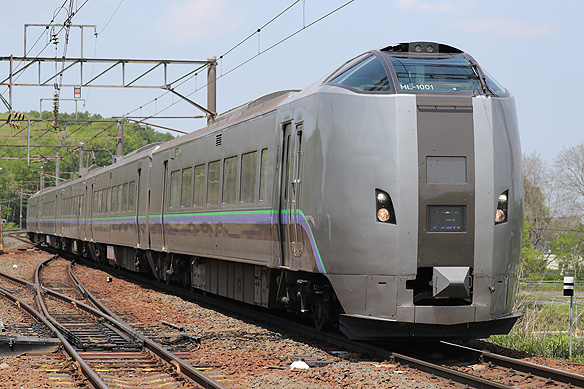
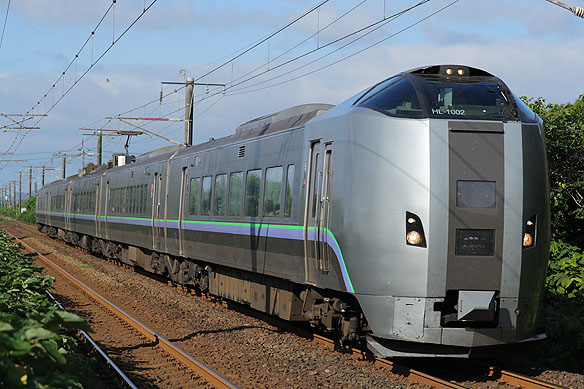
In 2007, JR Hokkaido introduced the 789-1000 series EMUs, featuring substantial improvements over the earlier 789-0 series. These new units replaced the aging 781 series, which had operated on intercity services linking Asahikawa and Muroran via Sapporo since 1978.
A total of seven five-car sets, each consisting of two powered cars and three trailer cars, were delivered and assigned to these services.
Car body
Car Body The carbody of the 789-1000 series measures 20,800 mm in length and 2,900 mm in width, with a bogie centre distance of 14,400 mm. It shares the same cross-sectional profile as the 789-0 series, designed to accommodate up to 3 degrees of tilting. The structure is primarily composed of lightweight stainless steel, with the exception of the bolster beams, end sections of the centre beam, and selected cross members, which are fabricated from corrosion-resistant steel plate.
Anti-fall plates are installed between vehicles, except at the cab ends. Laser beam welding is applied to the side structure to minimize skin distortion. Structural reinforcement is achieved through a ring-shaped arrangement of longitudinal members—including underframe cross members, side columns, and carlines—enhancing resistance to lateral collision forces.
The cab ends are constructed from 3.2 mm thick steel plate and differ from
the 789-0 series in having no gangway door and a high-mounted driver's
cab for improved protection against obstacles at level crossings. A built-in
classification headboard is fitted at the centre of the cab end. On either
side of the headboard, two vertically arranged headlights—one halogen
and one high-intensity discharge (HID)—are installed. Additional
HID lamps are mounted above the windscreen, and taillights are positioned
behind it.
Each car is equipped with two single-leaf stepped sliding doors. These
doors employ pneumatic cylinders that press the door panels against the
frame to prevent ice intrusion, facilitating boarding and alighting during
"Airport" rapid services. Side windows include small fixed double-glazing
units for each seat in the U-seat class, and wide fixed double-glazing
windows aligned with two-seat bays in the standard class. The rear door
of trailer-end cars and the front door of intermediate powered cars are
900 mm wide, while all other doors are 700 mm wide. All side windows are
reinforced with polycarbonate to prevent breakage.
The conductor's room in Class Moha789-2000 and the driver's cabs in Class
Kuha789-1000 and -2000 are equipped with hinged doors, excluding the main
doorways. Three-colour LED destination indicators (red, green, and orange)
are mounted on each side of the carbody.
Each car is fitted with an N-AU789A air-conditioning unit rated at 30,000 kcal/h, mounted on the roof. Fresh air is supplied to the passenger compartment via electric fans integrated into the air-conditioning system, replacing conventional roof ventilators. To prevent snow and ice accumulation, 1 mm thick stainless steel cover plates are installed between underfloor equipment. The bottom level of underfloor components is limited to a height of 234 mm, which is 49 mm higher than on previous models.
Bogies
The motored bogies are designated as type N-DT789A, while the trailer bogies
are type N-TR789A. Both types feature bolster-less secondary air suspension,
a trailing-arm type journal box support system, a single-link traction
gear, and yaw dampers to ensure smooth ride characteristics even at speeds
up to 140 km/h. The wheel diameter is reduced to 810 mm to lower the vehicle's
centre of gravity.
Power transmission is achieved through Twin Disc (TD) flexible joints incorporating deflecting plates made of carbon-fiber-reinforced plastic (CFRP). The gear ratio is set at 4.43 to provide high acceleration performance across medium- and high-speed ranges, with a maximum service speed of 140 km/h.
The bogies are equipped with double-tread brake rigging. In addition, trailer bogies are fitted with disc brake rigging.
Traction unit and ancillary equipments
Class Moha789-1000 and -2000 vehicles are equipped with the N-CI789A traction system, consisting of a three-level converter and a two-level variable-frequency drive (VFD) employing IGBT modules. This system controls four N-MT731 AC asynchronous traction motors per bogie; each rated at 230 kW.
In contrast, Class Moha789-200 vehicles are fitted with the N-CI789-3 traction system, which also implement vehicle-based control and utilizes two-level invertors incorporation IGBT modules. These systems feature field-oriented control and governs the traction motors on a per-truck basis.
Intermediate trailer vehicles, Class Saha885-0, are equipped with two underfloor N-TM789-AN traction transformers, which utilize traveling wind for self-cooling and supply power to both Class Moha789-1000 and -2000 vehicles. Motored vehicles are fitted with underfloor equipment to remove airborne snow from intake air.
Class Saha788 vehicles are equipped with a roof-mounted single-arm pantograph (PS789) for current collection.
End cars, Class Kuroha789-100 and Kuha789-200, are equipped with the N-APS785 ancillary power supply unit. This unit consists of a rectifier formed by a hybrid bridge circuit combining diodes and thyristors, powered via the tertiary winding of the traction transformer. It supplies 100 V DC at 12 kW. Additionally, an IGBT inverter employing pulse-width modulation (PWM) provides two 100 V AC output circuits rated at 7.5 kVA, mounted under the floor.
End cars are also equipped with a motor-driven screw-type air compressor (N-MHI785-C2000ML), installed under the floor.
The 789-1000 series features an electrically commanded braking system with regenerative braking down to zero speed, incorporating a holding brake function and trailer-priority brake control logic.
Accommodation
All seats are adjustable reclining types and equipped with hand-grabs. U-seat class vehicles feature 2+2 abreast seating with a pitch of 1,050 mm, while standard class vehicles also have 2+2 seating with a pitch of 960 mm. U-seat class seats are fitted with power outlets located behind the seat backs.
The door between the vestibule and passenger saloon is automatic, activated by a photo sensor. Above this door, an LED display provides passenger information. Cabin lighting consists of alternating light-coloured fluorescent lamps and LED fixtures.
Class Kuha789-1000 and -2000 vehicles are equipped with a Western-style toilet and a flush urinal, both using chemical holding tanks. These vehicles also include a washroom. Class MoHh789-2000 vehicles are equipped with a universal access toilet and a conductor's room. A baggage rack is also provided in the passenger saloon of Class Moha789-2000.
Operations
The 789-1000 series EMUs entered service in October 2007 on "Super
Kamu" intercity services linking Sapporo and Asahikawa, as well as
on "Airport" rapid services connecting Sapporo and New Chitose
Airport. In 2010, the series was also introduced on "Suzuran"
intercity services between Sapporo and Muroran.
Subsequently, the 789-1000 series was withdrawn from "Airport"
rapid services following the discontinuation of through-operation between
"Super Kamui" and "Airport" services. The "Super
Kamui" service was later split into two separate intercity services:
"Lilac" and "Kamui."
The 789-1000 series is currently assigned to "Kamui" and "Suzuran" intercity services. |
|