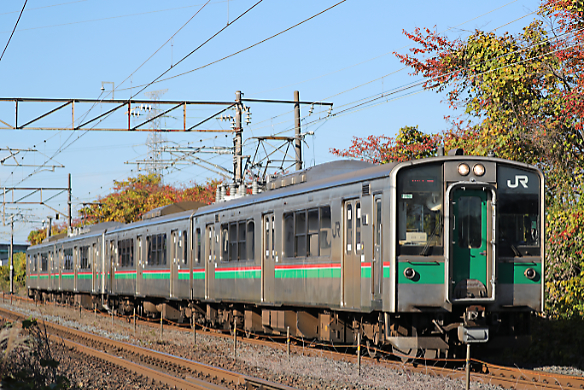
Background and overview
JR East planned to introduce additional 701 series EMUs to replace the 715-1000 series operating in the Sendai region. Accordingly, the 701-1500 series was developed in 1998, incorporating several improvements over the earlier 701 series EMUs.
The fleet consists of two-car sets, and a total of seven two-car sets were delivered to the Sendai Depot in 1998.
Car body
The carbody of the 701-1500 series measures 19,500 mm in length and 2,870 mm in width, with a bogie centre distance of 13,800 mm. The structure is primarily composed of stainless steel, except for the bolster beams, the end sections of the centre sill, and selected cross beams, which are fabricated from weather-resistant steel plate (Steel Plate Atmospheric).
The body employs Kawasaki’s two-sheet spot-welded stainless steel structure, in which a pressed inner stainless steel sheet is spot-welded to an outer sheet. This double-skin construction provides the required rigidity without bead embossing. The exterior consists of unpainted flat stainless-steel panels, complemented by a green waistline band with a narrow red accent band, and green bands applied below the windscreens.
The cab end is gangway-equipped, incorporating a gangway door and a low-profile driver’s cab. Flat windscreens are adopted to reduce manufacturing costs. Lighting equipment consists of two sealed-beam headlights mounted above the gangway door and two taillights positioned below the windscreens. An LED destination display is mounted above the co-driver’s-side windscreen.
Each car is fitted with three 1,300 mm-wide double-leaf automatic stepped sliding doors on each side. Door operation is controlled by TK113C units employing pneumatic direct-drive mechanisms mounted above the door headers. Manual operation is enabled via push-button controls located adjacent to each door.
Between the doors, the side panels are fitted with a horizontal band of four windows, including two double-hung side windows with a height of 960 mm, except for a pair of fixed windows adjacent to the toilet compartment. Additional fixed windows are installed at each end of the carbody. All windows employ heat-absorbent glass, eliminating the need for blinds.
LED destination indicators and external loudspeakers—used for platform-side passenger announcements—are installed on each side of the carbody.
A roof mounted AU710A air-conditioning unit, rated at 38,000 kcal/h, is installed at the centre of the roof. No roof ventilators are provided.
End cars are equipped with an automatic jumper coupler to facilitate rapid turn-back operations.
Bogies
The powered bogies are designated DT61A, while the trailer bogies are classified as TR246A, the same types used on the 701-0 series. Both bogie types employ bolsterless secondary air suspension and trailing-arm link journal box supports. Traction force is transmitted via a single-link draw gear.
Both bogie types incorporate a bow-shaped frame design, adopted to lower the bolster-suspension height and thereby contribute to a reduced floor level. The distance between the two secondary suspension units is 200 mm narrower than on the earlier standard TR235 bogie, allowing the secondary suspension assemblies to be mounted directly onto the side frames, thereby simplifying the bogie frame construction.
Power transmission utilizes Twin Disc (TD) flexible couplings with carbon-fiber-reinforced plastic (CFRP) deflecting plates, with a gear ratio of 7.07.
The braking configuration differs between bogie types: powered bogies are equipped with single-tread brake rigging, while trailer bogies combine single-disc brake units with single-tread brake rigging.
Powertrain and ancillary equipment
Class Kumoha701-1500 cars are equipped with the CI10 traction system, which controls four MT65 three-phase AC asynchronous traction motors on a per-bogie basis, each rated at 125 kW. The traction system comprises a three-level PWM converter utilizing IGBTs, paired with a two-level variable-frequency drive (VFD) employing power transistors, and incorporates regenerative braking, eliminating the need for a roof-mounted braking resistor.
Class Kumoha701-1500 cars are also fitted with an SC49 auxiliary power supply unit and a TM29 traction transformer, both mounted beneath the floor. Current collection is provided by a PS105 lozenge-shaped pantograph, featuring a reduced folding height, mounted on the roof of the powered end car.
Class Kuha700-1500 end cars are equipped with an MH1112-C1600MF motor driven air compressor mounted beneath the floor.
The braking system is an electrically commanded brake with regenerative braking.
Accommodation
Passenger accommodation features longitudinal bench-type bucket seating throughout. Each bench is fitted with end partition panels to reduce cold-air intrusion. The air-conditioning ductwork is installed above the ceiling, maintaining a clean interior profile, with slit-type vents providing evenly distributed airflow.
The cab is a left-side compartment-type design, optimized for conductor-less operation. Each car is equipped with ticket vending machines located near the doorways, as well as fare chart displays and fare boxes positioned behind the driver’s cab. A 1,200 mm-wide double-leaf sliding door is fitted at the gangway to facilitate movement between cars during conductor-less operation.
Class Kuha700-1500 trailer end cars are equipped with a universal-access toilet incorporating a chemical holding tank. A wheelchair space is provided across the aisle from the toilet.
Additional delivery
JR East additionally delivered ten two-car sets to the Sendai Depot between
February and March 2001.
Modification and refurbishment
A refurbishment programme for the 701-1500 series commenced in 2011. The original CI10 traction system was replaced with the CI19A traction unit, comprising a three-level PWM converter employing Insulated Gate Bipolar Transistors (IGBTs) and a two-level variable-frequency drive (VFD), also employing IGBTs. This system controls four MT65 AC asynchronous traction motors on a per-bogie basis. In the event of a failure in one of the two traction circuits, the failed circuit can be isolated, providing enhanced redundancy.
The traction transformers were upgraded to TM32A units, which incorporate measures to reduce harmonic-current heating. The auxiliary power supply was replaced with the SC93 unit, featuring IGBT technology.
Operations
The 701-1500 series was operated on the Tōhoku Line between Kuroiso and
Ichinoseki, and is currently deployed on rural services of the Tōhoku Line
between Shin-Shirakawa and Ichinoseki. |
|
| Technical Data |
| Items |
Data |
| Supply
Voltage |
20,000 V AC, 50 Hz |
| Service
speed, etc. |
Service speed: 110 km/h |
| Length |
19,500 mm |
| Width |
2,950 mm |
| Height |
3,670 mm |
| Bogie |
DT61A (motored) TR246A (trailer) |
| Collector |
PS105 |
| Traction
motor |
MT65 (125 kW) |
| Gear
ratio |
7.07 |
| Transformer |
TM26/TM32A |
| Traction system |
Converter and variable frequency drive a per-bogie basis (CI10/CI19A) |
| Air
conditioner |
AU710A (38,000 kcal/h) |
| Designed
by |
JR East |
|
|