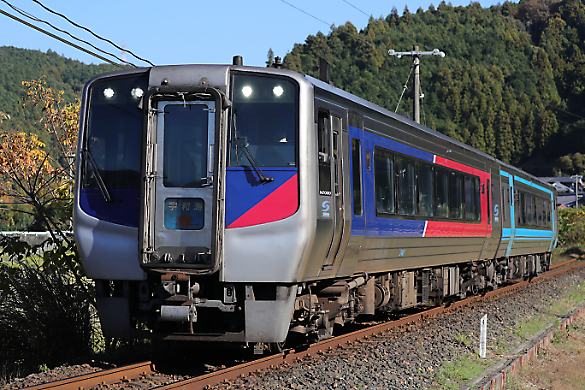
Background and overview
JR Shikoku built two additional 2000 series vehicles in 1995 to provide extra capacity for intercity services linking Matsuyama and Uwajima. This set, designated the N2000 series, incorporates several improvements for 130 km/h operation, intended to reduce journey times on the Kōtoku Line in anticipation of the opening of the Akashi Strait Bridge in 1997.
Car body
The car bodies of the N2000 series measure 20,800 mm in length and 2,839 mm in width, with a bogie centre distance of 14,400 mm. The floor height is set at 1,105 mm to lower the vehicle’s centre of gravity and eliminate the level difference between the platform and the floor, thereby improving accessibility. The structure is primarily composed of stainless steel, while the bolster beams, the end sections of the centre sill, and selected cross beams are fabricated from weather-resistant steel plate (Steel Plate Atmospheric). To accommodate 5 degrees of tilting, the side structures are narrowed upward and downward and incorporate curved roof shoulders with a radius of 350 mm to ensure the cross-sectional profile remains within the loading gauge.
The exterior features unpainted bead-stiffened stainless-steel panels, 1.5 mm thick, with a light-blue waistline band running below the windows along each car. Side doors are finished entirely in red.
Cab ends are gangwayed and equipped with a central gangway door flanked by flat windscreens. The driver’s cab is elevated 300 mm above floor level to improve forward visibility and provide additional protection against obstacles at level crossings. The lighting equipment consists of two pairs of rectangular sealed beam headlights arranged on either side of the gangway door, with rectangular LED tail lamps positioned between the headlight pairs. The corners of the cab ends are covered with decorative FRP frames.
The vehicles are equipped with 810 mm wide sliding plug doors that provide airtight sealing at both ends, except for the rear doors of Class 2400 vehicles, which measure 900 mm. A built-in classification roller-blind headboard is mounted centrally on the gangway door. Side windows are 1,560-mm-wide double glazed units aligned with two seat bays.
A three-colour LED destination indicator is mounted on each side panel, and LED car-number and seating-class indicators are installed adjacent to each door.
Climate control is provided by two outdoor units of the prime-mover-driven AU26 air-conditioning system, each rated at 16,000 kcal/h and mounted beneath the floor, together with two indoor units installed on the roof. Three electric fans within the system supply fresh air into the passenger saloon, eliminating the need for roof-mounted ventilators.
Exhaust pipes for the prime mover are routed inside the body side walls at each end of the vehicle, except for one exhaust pipe located immediately behind the cab.
The vehicles are equipped with tight-lock couplers incorporating automatic jumper couplers.
Bogies
The S-DT61 bogies feature single-axle drive and employ bolsterless secondary air suspension, coil-spring primary suspension with cylindrical laminated-rubber elements, a single-link traction device, and yaw dampers to ensure stable ride characteristics at speeds up to 130 km/h. To lower the centre of gravity, the wheel diameter is reduced to 810 mm. The gear ratio of the powered bogies is 2.353.
The tilting mechanism combines a pneumatic cylinder, which suppresses abrupt tilting, with a roller-tilting system enabling up to 5 degrees of tilt. The bogie frame adopts a bow-shaped welded structure to accommodate the tilting frame and roller-tilting mechanism. This controlled passive tilting system allows curve negotiation at speeds approximately 30 km/h higher than conventional speed limits. The roller tilting mechanism is enclosed in a dustproof cover.
The controlled-pendulum tilting system installed on Class 2450 vehicles calculates the train’s running position using signals from speed generators mounted on the trailing wheels and corrects this position based on data from the onboard ATS signalling system. It then outputs commands for tilt initiation timing and tilt angle, determined by the location of the upcoming curve and the current travel speed.
The bogies are equipped with hydraulic pressure-applied caliper wheel-disk brake rigging, and anti-slip control is provided by axle-driven tachometer generators installed on each axle.
Powertrain and ancillary equipment
The vehicles are powered by two four-cycle, straight-six diesel prime movers (type SA6D125‑H1), each rated at 350 PS. These engines are equipped with an exhaust-gas-driven turbocharger and an intercooler to enhance output and thermal efficiency.
The hydraulic transmission system, designated type TACN-22-1601, features a three-element single-stage torque converter, a multi-plate wet clutch, and a two-range direct-coupled drive. Both the prime movers and the hydraulic transmissions are controlled by a programmable logic controller (PLC), which reduces the complexity of the control equipment and improves system reliability.
An electrically commanded pneumatic braking system is employed, incorporating both engine braking and Jake braking. When engine or Jake braking alone cannot provide the required braking force, the pneumatic brake system automatically supplements it.
Accommodation
Seating accommodation consists of 2+2 abreast adjustable reclining seats with a pitch of 980 mm. Sliding curtains are fitted to the side windows.
The air-conditioning ductwork is installed above the ceiling to maintain a clean interior profile, with slit-type vents providing evenly distributed airflow. Electric warm air heaters are mounted beneath the seating. Cabin lighting is provided by two rows of covered fluorescent light fixtures.
The door between the vestibule and the passenger saloon is automatic and activated by a photo sensor. An LED passenger-information display is mounted above this door.
A Class 2450 car is equipped with a Japanese-style toilet and a washroom constructed from fibre reinforced plastic, while a Class 2400 car is fitted with a universal-access toilet and a washroom. Both are located at the rear end of the car. Both incorporate chemical holding tank system.
Additional delivery
Vehicles built from 1997 onward differ from the earlier batch in both car-body structure and interior accommodation. The end structure incorporates a strengthened gangway-connection base, and the driver’s cab is mounted 400 mm higher above floor level to improve protection against obstacles at level crossings. As a result of this modification, the clusters comprising the headlights and tail lamps were relocated to positions above the windscreens. In addition, the exterior livery was revised to include blue and rose-pink accent bands around the side windows and below the windscreens.
On Class 2400 vehicles, the door of the universal-access toilet was changed to a motorized type, and a flip-up diaper-changing station was added. Furthermore, a flush urinal was newly installed at the rear of the washroom. Conversely, Class 2450 vehicles were additionally equipped with a payphone booth located adjacent to the rear doorway.
Operations
Two vehicles were built in 1995 to enter the Nampu intercity services linking Okayama and Kochi, and the Shimanto intercity services linking Takamatsu and Kochi, operating alongside the
earlier built 2000 series sets. Four Class 2500 intermediate vehicles were
delivered to Takamatsu Depot in 1997 to provide additional capacity for
the Nampu and Shimanto services. Five Class 2400 and 2450 end cars were subsequently built to enter the Uzushio intercity services linking Okayama and Takamatsu with Tokushima, operating together with the Class 2500 cars.
The Uzushio services began 130 km/h operation in 2011. However, some N2000 series
cars assigned to the Uzushio services were replaced by the 2600 series DMUs in 2017. In addition, the 2000 series vehicles used on the Uzushio services began to be replaced by the 2700 series DMUs in 2019, and the
N2000 series sets were completely withdrawn from the Uzushio services in 2020.
The N2000 series sets are currently assigned to the Uwakai intercity services linking Matsuyama and Uwajima, and the Ashizuri intercity services linking Kochi and Sukumo. |
|