Background and overview
Following the privatization of Japanese National Railways (JNR) in 1987, JR Shikoku faced financial constraints due to its limited business foundation. To support stable operations under these conditions and replace superannuated diesel multiple unit trains used for express services, JNR developed the Kiha185 series diesel multiple unit trains for intercity services in Shikoku in 1986.
Except for the first- and standard-class combined cars, Class Kiha186, the Kiha185 series end cars are equipped with gangway doors to facilitate easy coupling and decoupling of trainsets, thereby enhancing operational flexibility. The equipment room was omitted to avoid reducing seating capacity.
The Kiha185 series comprises Class Kiha185 standard-class end cars and Class Kiroha186 intermediate combined cars.
A total of thirty-eight units were manufactured and delivered to the Takamatsu Depot in 1986.
Car body
The carbody of the Kiha185 series measures 20,800 mm in length and 2,900 mm in width, with a bogie centre distance of 14,400 mm. The structure is primarily composed of lightweight stainless steel, except for the bolster beams, end sections of the centre beam, and selected cross members, which are fabricated from corrosion-resistant steel plate. The body uses 1.5 mm-thick bead-stiffened side panels and 0.6 mm-thick roof panels.
The cab end is gangwayed and covered with a fibre-reinforced plastic (FRP)
panel consisting of five parts, incorporating a gangway door, reinforced
front structure, and a driver's cab elevated 300 mm above floor level.
This raised position and reinforced construction improve forward visibility
and provide additional protection against obstacles at level crossings.
Wide curved windscreens are placed on either side of the gangway to provide
a commanding view of the tracks ahead. An illuminated classification headboard
is mounted on the gangway door. Clusters of a rectangular sealed-beam headlight
and a rectangular taillight are mounted above the windscreens.
Each side of the vehicle is equipped with two 850 mm-wide automatic folding stepped doors. Between the doors of Class Kiha185 end cars, 1,475 mm-wide fixed double-glazing side windows aligned with two-seat bays are installed. By contrast, the side windows of Class Kiroha186 include 965 mm-wide fixed double-glazing units for each first-class seat located toward the front, and 825 mm-wide units for each standard-class seat toward the rear. Traditional destination rollsigns are mounted on the carbody sides.
Climate control is provided by two outdoor units of prime mover-driven air conditioners (type AU26), each rated at 20,600 kcal/h and mounted beneath the floor, along with two indoor units installed on the roof. Three roof-mounted ventilation fans—originally developed for bus applications—are installed above Class Kiha 185 vehicles, and four above Class Kiroha 186 vehicles. Prime mover exhaust pipes are installed both behind the cab and at the rear end of the body.
The exterior features an unpainted body accented by emerald green waistline and headline bands running the full length of the car below and above the windows. Emerald green colour accents are also applied around the windscreens of the cab ends.
Bogies
The powered bogies are designated DT55 and incorporate a single-axle drive system. Trailer bogies are classified as TR240. They feature bolster-less secondary air suspension, conical multilayer rubber-spring journal supports, and a Watts linkage draw gear. The bogie structure includes provisions for the future installation of yaw dampers to enhance ride quality and lateral stability.
The gear ratio of the powered bogies is set at 2.976. Both bogie types utilize double-tread brake rigging.
Traction unit and auxiliary equipments
Class Kiha185 vehicles are powered by two horizontally mounted DMF13HS diesel engines—four-cycle, straight-six prime movers—while Class Kiroha186 vehicles are powered by a single prime mover installed beneath the floor. Each engine delivers an output of 250 PS and features a turbocharger driven by exhaust gas flow, a direct injection system, and a fuel injection control system designed to improve fuel efficiency.
The hydraulic transmission, either TC2A or DF115A, was sourced from decommissioned
diesel multiple units and upgraded with enhancements to the torque converter
and clutch to accommodate the increased engine output. The TC2A model also
underwent modification to reposition the hydraulic/direct-drive stage changeover
servo piston, preventing interference with the engine's gear case.
Two air compressors (model C600), driven by the prime mover, are mounted beneath the floor of Class Kiha185 vehicles. In contrast, Class Kiroha186 vehicles are equipped with one air compressor and an auxiliary power unit (FD3304) for the air conditioners, also mounted beneath the floor.
The braking system is the automatic electromagnetic (CLE) air brake.
Accommodation
First-class accommodation in class Kiroha186 vehicles features 2+2 abreast reclining seats (type R36) with a pitch of 1,160 mm, while the standard-class section is fitted with 2+2 abreast flip-over transverse seats (type W12) with a pitch of 1,020 mm. By contrast, Class Kiha185 standard-class vehicles adopt 2+2 abreast reclining seats (type R55) with a pitch of 940 mm.
The door between the vestibule and the passenger saloon is automatic, operated
by a photo sensor. A conductor's room is located adjacent to the front
doorway of class Kiroha186 vehicles.
Class Kiha185-0 units include a Japanese-style toilet located at the rear of the carbody. This facility utilizes chemical holding tanks.
Additional delivery
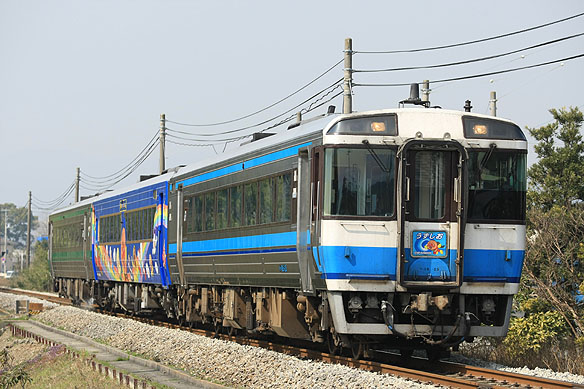
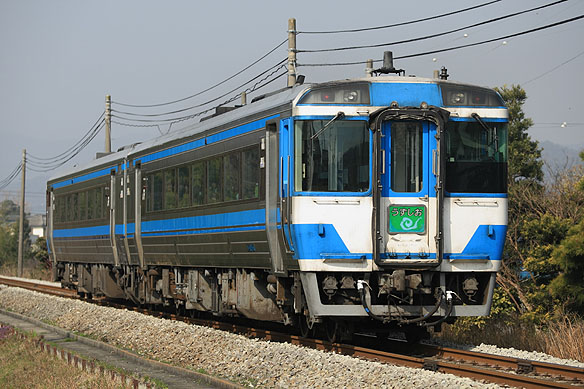
Eight class Kiha185-0 vehicles and six class Kiha185-1000 vehicles, additionally built in 1988, were equipped with newly developed hydraulic transmission gear designated DB115 and introduced with a new livery featuring light blue accents.
Modifications
Modifications for Transfer to JR Kyushu
JR Kyushu inherited twenty surplus Kiha 185 series vehicles, which had been replaced by 2000 series DMUs, and modified them for deployment on upgraded intercity services. These trains entered service on the Yufu and Hino-Yama express routes in 1992.
Car body
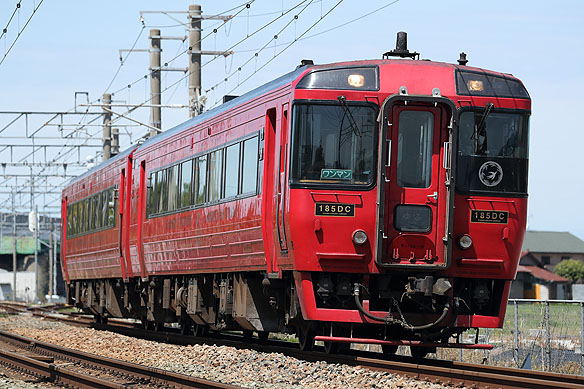
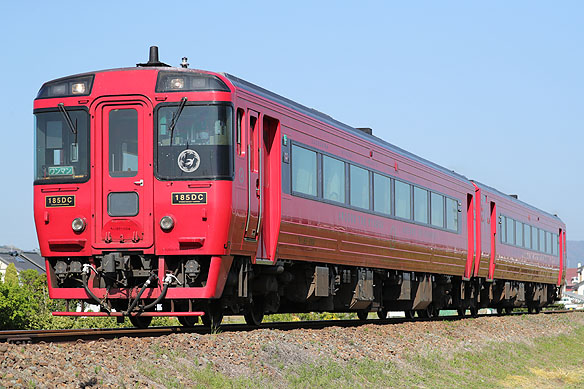
The cab end and the upper part of side panels were finished in red.
Powertrain and Ancillary Equipment
An additional prime mover (type DMF13HS) and an additional hydraulic transmission unit (TC2A or DF115A) were fitted in place of the auxiliary power unit (FD3304), which had previously been deployed for powering the air conditioners.
Accommodation
In selected class Kiha185-0 vehicles, two rows of seats at the rear of the saloon were removed to introduce a catering room and a pay-phone room.
In addition, the flip-over transverse seating of class Kiroha186 vehicles was replaced with reclining seats, and the first-class section was downgraded to standard class. For this reason, Class Kiroha186 was reclassified as class Kiha186.
Seating was upholstered in black.
Refurbishment programme
JR Kyushu revised the livery of the Kiha185 series, finishing the entire body in red. In addition, fog lamps were fitted on either side of the gangway at the lower part of the cab end.
Furthermore, the passenger saloon was refurbished with a wooden floor finish, and the overhead luggage racks, seat-back tables, and seating armrests were replaced with wooden fittings. The Japanese-style toilet in class Kiha185-0 vehicles was also replaced with a Western-style toilet featuring a vacuum system.
Prime mover replacement
JR Kyushu commenced the prime mover replacement programme for the Kiha 185 series in 2008. The SA6D125-HE1-K32 prime mover manufactured by Komatsu Ltd. was adopted, with its power output limited to 250 PS. In conjunction with this, TACN-22-1612C hydraulic transmission gear supplied by Hitachi Nico Transmission Co., Ltd., featuring a two-stage direct-coupled range, was employed.
Operations
JR Shikoku
A total of 38 Kiha185 series DMUs were manufactured and initially allocated to the Takamatsu Depot between August and October 1986. They entered revenue service on the Shiokaze and Nampu intercity routes.
In conjunction with the opening of the Great Seto Bridge, the Shiokaze and Nampu intercity services were changed from Takamatsu-originating to Okayama-originating. In addition, the Kiha185 series was deployed on the Ishizuchi intercity service linking Takamatsu and Uwajima, the Shimanto service linking Takamatsu and Nakamura, and the Uzushio service linking Okayama and Tokushima, as well as on Shiokaze services between Okayama and Uwajima and Nampu services between Okayama and Nakamura.
However, Kiha185 series trains on the Shiokaze route were replaced by 2000 series DMUs in 1990, and the 2000 series also entered Nampu services. By 1991, the Kiha 185 series was reduced to operating only one round trip of Nampu services, before being completely withdrawn from the route.
In contrast, the trains were introduced on the Tsurugi-san intercity service linking Tokushima and Awa-Ikeda in 1996, and on the Muroto intercity service linking Tokushima and Mugi in 1999. Eventually, the Muroto service was abolished, and the Kiha 185 series was completely withdrawn from Uzushio services in 2025. At present, they remain in operation on the Tsurugi-san intercity service.
JR Kyushu
Kiha185 series DMUs inherited by JR Kyushu from JR Shikoku replaced the aging Kiha58 series and Class Kiha65 units on the Kyudai Line Yufu express service and the Houhi Line Hino-Yama express service. They subsequently entered the Yufu and Aso intercity services in 1992.
The Kiha185 series was also introduced on the Kumagawa intercity service, which had been upgraded from the Kumagawa express service linking Kumamoto and Hitoyoshi, and on the Trans-Kyushu Limited Express intercity service linking Beppu and Hitoyoshi via Kumamoto. This latter service was created through the extension of selected Aso intercity services following the opening of the Kyushu Shinkansen between Shin-Tosu and Kagoshima-Chuo in 2004.
Eventually, the Kumagawa intercity service and the Trans-Kyushu Limited Express service between Kumamoto and Hitoyoshi were completely abolished in 2016. At present, the Kiha185 series is deployed on the Yufu intercity service linking Hakata and Beppu via the Kyudai Line, and on the Trans-Kyushu Limited Express intercity service linking Kumamoto and Oita via the Houhi Line. |
|