Background and overview
In 1999, JR Shikoku modified surplus class Kiha185-1000 vehicles to enable
operation in conjunction with general-purpose DMUs, replacing the aging
Kiha58 series and class Kiha65 units. These modified vehicles were reclassified
as the Kiha185-3100 series.
Car body
The carbody of the Class Kiha185-3100, converted from Class Kiha185-1000, measures 20,800 mm in length and 2,900 mm in width, with a bogie centre distance of 14,400 mm. The structure is primarily composed of lightweight stainless steel, except for the bolster beams, end sections of the centre beam, and selected cross members, which are fabricated from corrosion-resistant steel plate. The body uses 1.5 mm-thick bead-stiffened side panels and 0.6 mm-thick roof panels.
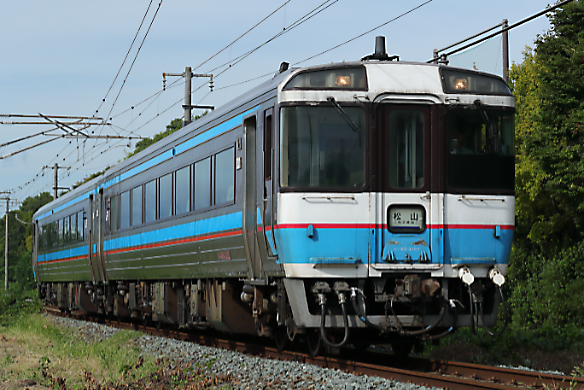
The cab end is gangwayed and covered with a fibre-reinforced plastic (FRP)
panel consisting of five parts, incorporating a gangway door, reinforced
front structure, and a driver's cab elevated 300 mm above floor level.
This raised position and reinforced construction improve forward visibility
and provide additional protection against obstacles at level crossings.
Wide curved windscreens are placed on either side of the gangway to provide
a commanding view of the tracks ahead. A destination rollsign is mounted
on the gangway door instead of a classification headboard. Clusters of
a rectangular sealed-beam headlight and a rectangular taillight are mounted
above the windscreens.
Each side of the vehicle is equipped with two 850 mm-wide automatic folding stepped doors. Between the doors, 1,475 mm-wide fixed double-glazing side windows aligned with two-seat bays are installed.
A special jumper coupler converting a KE93 jumper plug to two KE53 jumper plugs is installed beneath the floor at the cab end, enabling operation in conjunction with general-purpose DMUs.
Climate control is provided by two outdoor units of prime mover-driven air conditioners (type AU26), each rated at 20,600 kcal/h and mounted beneath the floor, along with two indoor units installed on the roof. Three roof-mounted ventilation fans—originally developed for bus applications—are installed. Prime mover exhaust pipes are installed both behind the cab and at the rear end of the body.
The exterior features an unpainted body accented by a light blue waistline with a narrow red band, and headline bands running the full length of the car below and above the windows. Light blue colour accents are also applied around the windscreens of the cab ends.
Bogies
The bogies are designated DT55 and incorporate a single-axle drive system. They feature bolster-less secondary air suspension, conical multilayer rubber-spring journal supports, and a Watts linkage draw gear. The bogie structure includes provisions for the future installation of yaw dampers to enhance ride quality and lateral stability.
The gear ratio of the powered bogies is set at 2.976. Both bogie types utilize double-tread brake rigging.
Traction unit and auxiliary equipments
The Kiha185-3100 series is powered by two horizontally mounted DMF13HS
diesel engines four-cycle, straight-six prime movers. Each engine delivers
an output of 250 PS and features a turbocharger driven by exhaust gas flow,
a direct injection system, and a fuel injection control system designed
to improve fuel efficiency.
Power transmission is handled by two DB115 hydraulic transmissions.
Two air compressors (model C600), driven by the prime mover, are mounted beneath the floor.
The braking system is the automatic electromagnetic (CLE) air brake.
Accommodation
The Kiha185-3100 series is fitted with 2+2 abreast rotatable transverse seats (type R55), which were modified by discontinuing the reclining function and removing the seat-back tables. The seats are arranged with a pitch of 940 mm.
The door between the vestibule and the passenger saloon is automatic, operated by a photo sensor.
Additional delivery
In 2000, two class Kiha185-0 vehicles were additionally converted to class
Kiha185-3000 vehicles.
Modification
In 2006, two class Kiha185-3000 vehicles were converted back to class Kiha185-0
vehicles to supplement the insufficient fleet required for deployment on
the Muroto intercity service, thereby providing additional capacity.
Operations
The Kiha185-3100 series entered rural services on the Yosan Line between Matsuyama and Uwajima and on the Yodo Line between Uwajima and Ekawasaki in March 2000. However, they were withdrawn from the Yodo Line in 2006.
At present, the Kiha185-3100 series is deployed on rural services of the
Yosan Line, linking Matsuyama and Uwajima. |
|