Background and overview
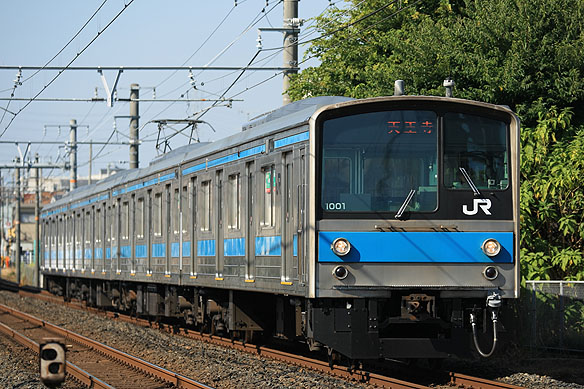
JR West developed the 205‑1000 series DC commuter electric multiple unit (EMU) trains in 1988, incorporating several improvements over the 205‑0 series to provide additional capacity on the Hanwa Line. In the same year, five four‑car sets—each consisting of two powered vehicles and two trailer vehicles—were built and allocated to the Hineno Depot.
Car body
The carbody of the 205‑1000 series measures 19,500 mm in length and 2,800 mm in width, with a bogie centre distance of 13,800 mm. The structure is primarily composed of stainless steel, except for the bolster beams, the end sections of the centre beam, and selected cross beams, which are fabricated from weather‑resistant steel plate (Steel Plate Atmospheric). The exterior features unpainted bead‑stiffened stainless‑steel panels with light‑blue waistline and headline bands running the length of each car below and above the windows.
The non‑gangwayed cab ends, which have no gangway door, are framed with decorative FRP panels. The driver’s cab is elevated 300 mm above floor level to improve forward visibility and provide additional protection against obstacles at level crossings. The flat and slanted windscreens are divided into a narrower glass pane on the driver’s side and a wider pane extended downward on the assistant driver’s side to provide a commanding view of the track ahead. A destination rollsign is mounted centrally behind the upper portion of the wider windscreen, while an operation‑number indicator—displaying the trainset‑level scheduling identifier—is implemented using a rotary disc located behind the upper portion on the left side of the wide windscreen. End vehicles are equipped with a longitudinally arranged sealed‑beam headlight with a taillight positioned below.
Each car is equipped with four double‑leaf automatic sliding doors, each 1,300 mm wide and 1,820 mm high—20 mm higher than those on 205‑0 series EMUs. Between the doors, the side panels feature pairs of drop windows measuring 920 mm in width, with additional drop windows provided at each end of the carbody. Door operation is controlled by TK4J units installed beneath the bench seats. Additional equipment includes a destination rollsign and two loudspeakers mounted on each side of the carbody to support passenger announcements.
Each car is fitted with a roof‑mounted WAU75H air‑conditioning unit rated at 42,000 kcal/h, featuring its own electric fans to supply fresh air into the passenger compartment. Each vehicle is also equipped with two roof‑mounted draught ventilators.
Couplers at the cab ends employ tightlock couplers, while all other connections use drawbars.
Bogies
The powered bogies are designated as type WDT50G, while the trailer bogies are classified as type WTR235G. Both types feature bolsterless secondary air suspension and conical multilayer rubber‑spring journal supports. The bogie structure includes provisions for the future installation of yaw dampers to enhance ride quality and lateral stability. Traction force is transmitted via the Watts linkage draw gear. The side beams of the bogie frame are straight in shape, and the bogie transom incorporates seamless pipes to achieve a lightweight and simple construction.
Power transmission utilizes a parallel cardan drive system with a hollow shaft. The gear ratio is 6.07, optimized to provide the same high‑acceleration performance at starting and the same maximum service speed as the 201 series EMU. Corrugated wheels are adopted for reduced weight, and a compound circular wheel profile is employed to minimize lateral forces exerted on the track.
The braking configuration varies by bogie type. Powered bogies are equipped with single‑tread brake rigging, while trailer bogies combine a single‑disc brake device with single‑tread brake rigging to enhance overall braking performance.
Powertrain and ancillary equipment
Series‑wound brushed DC traction motors (WMT61A), each rated at 120 kW,
operate at a higher rotational speed of 5,100 rpm to enable a maximum service
speed of 110 km/h. The eight traction motors on Class Moha205 and Class
Moha204 vehicles are controlled by the WCS57 armature‑resistance traction
control system, which incorporates field‑added excitation control. A naturally
ventilated traction resistor unit designated as WMR159 is employed. During
the armature‑voltage control stage, armature‑resistance control and series–parallel
control are applied. During the field‑weakening stage, the WHS52A field‑added
excitation system indirectly regulates the field current by controlling
the current of the inductive shunt. Forced‑field control provided by the
WHS52A enables regenerative braking. At low speeds, regeneration voltage
is maintained through series–parallel control, allowing regenerative braking
to remain effective down to approximately 20 km/h. If regenerative‑braking
performance falls below the required threshold, pneumatic braking is automatically
applied to supplement the braking force.
Current collection is handled by a WPS21 lozenge‑type pantograph mounted on the roof of Class Moha205‑1000 vehicles. Class Moha204‑1000 vehicles are equipped with an auxiliary power supply unit (WSC23) rated at 160 kVA, incorporating a boost converter, and a motor‑driven air compressor (MH3075‑C2000M), both mounted beneath the floor. The brake system features an electrically commanded braking system with regenerative‑braking capability. End vehicles are equipped with an onboard ATS‑S signalling system mounted beneath the floor.
Accommodation
The passenger saloon of the 205‑1000 series EMU is configured with fully longitudinal seating, with an individual seat width of 460 mm, to maximize capacity and facilitate smooth passenger flow during boarding and alighting. Each bench is fitted with end partition panels to delineate individual seating areas. Overhead luggage racks are constructed with pipe‑frame structures. Hanging straps are installed throughout the passenger compartment in two parallel rows along the ceiling to support standing passengers.
The air‑conditioning ductwork is installed above the ceiling to maintain a clean interior profile, with slit‑type vents providing evenly distributed airflow. Illumination is provided by fluorescent fixtures arranged in two parallel rows along the ceiling. The master controller employs a lateral‑motion operating handle.
Modification
Refurbishment Programme
JR West commenced a refurbishment programme for the aging 205‑1000 series between 2012 and 2013. This programme included several modifications.
A guide pontoon was retrofitted to the outside of each corner post by welding to improve crash‑energy dissipation and to deflect a colliding vehicle in offset‑collision scenarios. Destination rollsigns were replaced with LED destination displays. The windows on the side doors were replaced with laminated glass to eliminate the level difference between the glass and the interior panels.
Each car was retrofitted with an LED display installed above the header of each sliding door to provide passenger information. These locations also house door chimes for audible boarding notifications. Hanging straps were upgraded to larger looped handles—finished in green near priority‑seating areas and in orange elsewhere—to improve grip and visibility compared with earlier trains, and are fitted throughout the cabin. End vehicles are also equipped with a wheelchair‑accessible space located at the rear end.
Operations
JNR also delivered five four‑car sets for deployment on commuter services on the Hanwa Line in 1988 to provide additional capacity.
Later, the 225‑5100 series were introduced on the Hanwa Line to replace the remaining 103‑0 and 205 series EMUs operating on regional services. As a result, the 205‑1000 series were eventually reassigned to the Nara Line for regional operations.
At present, the 205‑1000 series operates on regional services on the Nara Line. |
|