Background and overview
Based on the operational experience gained with the earlier variants, JR
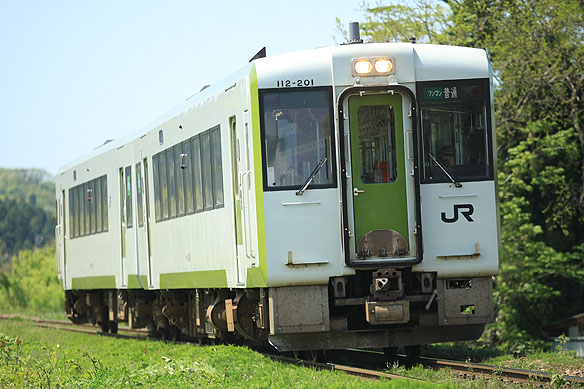
East developed the single‑ended Class Kiha111‑200 and Kiha112‑200 DMU trains
in 1993. This variant features conventional sliding doors with a lower
step to reduce the level difference between the platform and the floor
for improved accessibility. Class Kiha111‑200 vehicles are equipped with
a toilet, while the Kiha112‑200 vehicles are not. Eight vehicles of each
type were initially delivered to the Koriyama Depot.
Car body
The carbodies measure 19,500 mm in length and 2,928 mm in width, with a bogie centre distance of 13,800 mm. The body skin is fabricated from 1.6‑mm‑thick steel plate, while the roof uses 1.2‑mm plate. The floor height is 1,175 mm, which is 100 mm lower than that of earlier DMU types. The shoulders of the side structure, the underframe side beams, and the corners of the end structures feature chamfered profiles. The gangwayed cab incorporates a low‑profile driver’s cab, and an obstacle deflector is fitted beneath it.
Two rectangular sealed‑beam headlights are installed above the gangway door, and rectangular taillights are mounted in the upper section behind the windscreen. Destination rollsigns are provided above the driver’s‑side windscreen and on the side walls.
Each vehicle is equipped with two 1,000‑mm‑wide automatic stepped conventional sliding doors controlled by the TK103 door operating system. One door is located immediately behind the cab, while the other is positioned toward the rear of the body. As a result, the side‑wall depth at the door case is greater than on earlier Class Kiha111 or Kiha112 variants. The doors can also be operated manually using the buttons installed beside them. The step height at the doorway is 970 mm, 66 mm lower than previous variants, eliminating the level difference between the platform and the step and thereby improving accessibility. Fixed windows measuring 1,080 mm in width and employing laminated glass are fitted between the doors.
The vehicles are equipped with two outdoor units of the prime‑mover‑driven AU26J‑A air‑conditioning system, rated at 15,500 kcal/h, mounted beneath the floor. Two bus‑type ventilation fans and two indoor air‑conditioning units are installed on the roof. The exhaust pipe of the prime mover is located inside the cab.
Tight‑lock couplers with automatic jumper couplers are fitted at both ends to facilitate rapid coupling during rush‑up operations. The livery consists of a very pale green base with moss‑green accents applied to the chamfered areas.
Bogies
The powered bogies are type DT58A, incorporating a two‑axle drive system, while the trailer bogies are type TR242. Both bogie types feature bolster‑less secondary air suspension, a cone‑shaped multilayer rubber‑spring journal‑support system, and a Watts‑linkage draw gear. They have a wheelbase of 2,100 mm and employ unit‑assembled single‑tread brake rigging. The gear ratio of the powered bogies is set to 2.925.
Powertrain and ancillary equipment
The vehicles are powered by a DMF14HZA prime mover manufactured by Cummins Inc. This four‑cycle, straight‑six diesel engine develops 420 PS and is equipped with an exhaust‑gas‑driven turbocharger and an intercooler. The hydraulic transmission, designated as type DW14A‑B, features a three‑element single‑stage torque converter, a multi‑plate wet clutch, and a two‑stage direct‑coupled range. The prime mover and hydraulic transmission are controlled by a programmable logic controller to reduce the amount of control equipment and improve reliability.
The braking system is an electric‑command pneumatic brake with a retarder. When the retarder is no longer able to provide the specified braking force, the pneumatic brake supplements it.
Accommodation
The interior features a mixture of longitudinal bucket‑style bench seating and 2+1-abreast transverse bucket‑style seating bays with a seating pitch of 1,490 mm. The saloon is illuminated by two rows of covered fluorescent light fixtures, and a water‑heating system is installed beneath the seats.
The air‑conditioning duct is mounted on the ceiling shoulders, with spot diffusers installed on the duct surface and above the side windows to ensure even airflow distribution.
Kiha111‑200 vehicles are equipped with a Japanese‑style toilet constructed from fibre‑reinforced plastic, located immediately in front of the rear door. The master controller uses a lateral‑motion operating handle.
Additional delivery
Vehicles built from 1993 onward have carbodies measuring 20,000 mm in length, 500 mm longer than earlier Class Kiha111‑200 or Kiha112‑200 vehicles. The cab length was extended by 250 mm to improve protection against obstacles at level crossings. A wheelchair space is provided across the aisle from the toilet.
Vehicles built in 1999 for revenue service on the Rikuu‑East Line feature a new livery consisting of a white base with green accents applied to the chamfered areas and a red waistline band below the windows.
The bogies were upgraded with a cone‑shaped multilayer rubber‑spring journal support system. The powered bogies are designated as DT58B, while the trailer bogies are of type TR242A.
The toilet was redesigned as a universal‑access type and relocated to the rear end of the body. The windows were replaced with heat‑absorbing glass, eliminating the need for curtains.
Additional delivery
Vehicles built from 1993 onward have carbodies measuring 20,000 mm in length, 500 mm longer than earlier Class Kiha111‑200 or Kiha112‑200 vehicles. The cab length was extended by 250 mm to improve protection against obstacles at level crossings. A wheelchair space is provided across the aisle from the toilet.
Vehicles built in 1999 for revenue service on the Rikuu‑East Line feature a new livery consisting of a white base with green accents applied to the chamfered areas and a red waistline band below the windows.
The bogies were upgraded with a cone‑shaped multilayer rubber‑spring journal support system. The powered bogies are designated as DT58B, while the trailer bogies are of type TR242A.
The toilet was redesigned as a universal‑access type and relocated to the rear end of the body. The windows were replaced with heat‑absorbing glass, eliminating the need for curtains.
Operations
The vehicles were delivered to the Niitsu Depot in 1993 for use on rural services on the Banetsu‑West and Uetsu Lines.
Vehicles converted from Class Kiha111‑300 and Kiha112‑300 were transferred to the Nagano Depot for operation on the Joetsu, Iiyama, and Shinano Railway Lines.
The fleet was subsequently delivered to the Kogota Depot between October 1998 and October 1999 to replace Class Kiha40 vehicles deployed on the Ishinomaki, Kesennuma, Rikuu‑East, and Rikuu‑West Lines.
They are currently deployed on rural services on the Banetsu‑West, Uetsu, Ishinomaki, Kesennuma, Rikuu‑East, Rikuu‑West, Joetsu, Iiyama, and Shinano Railway Lines. |
|